


13
Islamabad


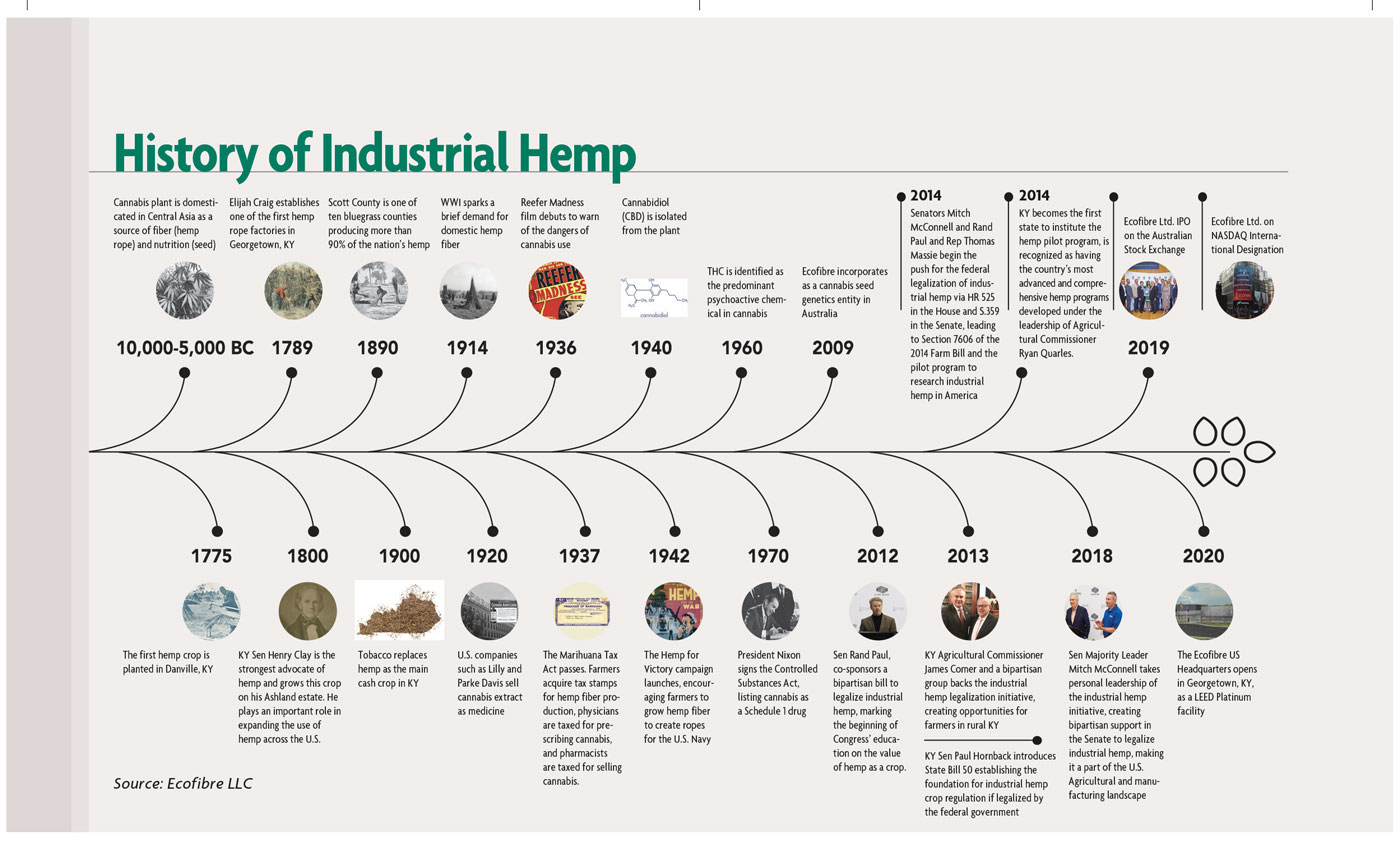
Hemp, one of the earliest known textile fibers, has seen heightened interest and a true resurgence since it was formally legalized, or perhaps relegalized, in the United States with the signing of the Farm Bill Act in 2018. The bill effectively removed industrial hemp from inclusion in the Controlled Substances Act (CSA).

The effort to legalize hemp
originated in 2014 with several bipartisan legislators initiating a push for
the legalization of industrial hemp. Section 7606 was included in the original
2014 Farm Bill, which allowed the creation of state-led pilot programs and
sanctioned the investigation of hemp for varied commercial and industrial
applications. Kentucky was the first state to institute a hemp pilot program
under this new legislation. The 2018 Farm Bill formally made commercial
production of hemp legal. The renewed focus on hemp has generated much
curiosity and interest, as well as technical studies, real and fake news — not
to mention product offerings — and flat-out misinformation passed through
various communication channels.
It’s difficult to talk about
hemp specifically without acknowledging its more publicized kin, marijuana. To
be clear, while both plants are derived from the cannabis family, hemp is not
marijuana. Marijuana is generally thought of singularly as a drug; while hemp
has been used for centuries in a variety of ways and uses including foodstuffs,
oils, rope, household and industrial textile products, as well as for
homeopathic or medicinal purposes. Technically, the two primary differences
between hemp and marijuana center around the respective amounts of two specific
cannabinoids, delta-9 tetrahydrocannabinol (THC) and cannabidiol (CBD) that
each plant contains. THC is the chemical component in cannabis plants that can
create mind-altering effects and get one “high.”
As part of the Farm Bill Act
of 2018, it was determined that marijuana be specifically defined as having a
THC content level greater than 0.3 percent. This definition kept marijuana on
the controlled substances list. Conversely, the THC level of hemp is almost
always significantly less than 0.3 percent so it was removed from the
controlled substances list — Of note: CBD must also contain less than
0.3-percent THC in order for it to be legally sold. So, using the simplest of
differentiators, marijuana will get you “high,” hemp will not.
CBD is a non-toxic chemical
substance produced by the hemp plant that has been used and proclaimed by
multiple cultures going back to ancient times as a dietary supplement with
medicinal and healing properties. These beliefs continued into the modern era,
but by the end of World War II and with the advent of modern medicines,
misinformation and negative perceptions towards cannabis plants in general
grew. The result of this misperception made it illegal to cultivate marijuana
and hemp.
The Marijuana Tax Act of 1937
effectively killed the hemp industry except for a brief respite during World
War II where hemp growth was encouraged to produce rope in support of the war
efforts. Ultimately, hemp’s use was greatly diminished in the United States
until new research and a changing social climate in the 1990s led to some
states legalizing the use of cannabis in treating certain medical conditions.
Since then, research into CBD, hemp extract and other derivatives, including as
a sustainable textile fiber and input, have grown substantially reigniting
hemp’s interest and acceptance.
While hemp’s CBD content has
been the primary driver in its recent resurgence, interest in its use as a
textile fiber also still persists. Historically, hemp may be one of the
earliest, if not the first sustainable industrial performance driven fibrous
raw material used in the production of textile products. And ironically, it’s
long and checkered history with numerous highs and lows in many ways mirrors
the highs and lows and resurrection of the textiles industry both in the United
States and globally. There is evidence of hemp fiber being used to improve
pottery as far back as 10,000 years ago, and it potentially was one of the
first known agricultural crops. Some of the earliest uses of hemp as a fiber
for textiles can be found dating back to 4,000 BC in China and Turkestan making
its initial use in textiles roughly 1,000 years earlier than that of cotton.
According to Kent Masterson
Brown, a Kentucky historian and award-winning producer of several documentaries
on American history: “The first planting of a hemp crop in the United States is
believed to have been in the 1600s at Jamestown in Virginia from hemp seeds
brought over by European settlers; who it should be noted, arrived aboard
sailing ships rigged with sails and rope made from hemp. Hemp was introduced to
Kentucky in the late 1700s where it was found to grow well, becoming one of
Kentucky’s largest cash crops.”
Brown should know as he
currently is raising the funds required to produce a new documentary film
detailing the history of hemp in the United States. The documentary’s working
title is “The Seed and Fiber of Wealth” and will tell the story of hemp’s
growth in the United States from the original settlers through the early 1900s,
the perceived negativity and demise associated with cannabis during the mid and
later 1900s and hemp’s present day rebirth.
“History told correctly helps
people warm to things and see them up front and personal,” Brown said. “I’m
hoping that this documentary will help people to understand hemp’s history and
that it is truly a sustainable plant of the future.”
 As
the U.S. welcomed in the 19th century, hemp found consistent increased growth
as a textile fiber, where it was made into products including rope, sailcloth,
clothing, paper and linens. “Hemp was a crop that governments generally wanted
to flourish because of its increasingly vital use in military applications,
especially for naval needs because of its natural resistance to rot and
mildew,” Brown offered. And keep in mind that in the 19th century, naval ships
meant sailing ships with large sails and intricate rope riggings. For example,
the USS Constitution — the famous naval sailing vessel also known as Old
Ironsides — “carried over 130,000 pounds of hemp rope on it in addition to
roughly 30,000 pounds of hemp sail cloth,” Brown noted. “That’s over 160,000
pounds of hemp on just one vessel.”
As
the U.S. welcomed in the 19th century, hemp found consistent increased growth
as a textile fiber, where it was made into products including rope, sailcloth,
clothing, paper and linens. “Hemp was a crop that governments generally wanted
to flourish because of its increasingly vital use in military applications,
especially for naval needs because of its natural resistance to rot and
mildew,” Brown offered. And keep in mind that in the 19th century, naval ships
meant sailing ships with large sails and intricate rope riggings. For example,
the USS Constitution — the famous naval sailing vessel also known as Old
Ironsides — “carried over 130,000 pounds of hemp rope on it in addition to
roughly 30,000 pounds of hemp sail cloth,” Brown noted. “That’s over 160,000
pounds of hemp on just one vessel.”
Hemp is one of the strongest
of available natural fibers for textile processing. It is significantly
stronger and more durable than cotton and provides better ultraviolet (UV)
protection than other natural fiber-based fabrics. Hemp also checks off virtually
all of the boxes required to be considered sustainable. It is naturally
hypoallergenic, antiviral, antibacterial and antimicrobial, which also is
beneficial to farmers because it can be grown in a more ecofriendly environment
with greatly reduced needs for fertilizers and pesticides. It requires less
water to grow than cotton and is generally acknowledged as being regenerative
of the soil leaving it in better condition than cotton growth. As a result,
farmers are able to rotate crops more effectively with hemp plantings.
According to Brown: “Hemp is
an annual plant that has become acclimated to and continues to grow well in
Kentucky, likely due to the soil’s limestone content. With hemp’s recent
legalization, it has again become a leading crop for many of the local
farmers.”
Because of the different
application needs of hemp plants, farmers have bred the plant into different
strains based on intended applications. For fibrous applications, mostly in
traditional textile configurations, a hemp strain has been genetically modified
to produce taller plants with lengthy fibrous stalks and fewer leaves or
flowers. Because CBD extract and oils are mostly derived from the hemp flowers,
these plants have been genetically modified to grow with very little stalk, less
fibrous material, and a much shorter growing height — but with an abundance of
flowering buds, which is then harvested in a similar manner to tobacco. For the
hemp strains, the goal is to maximize the consistency of resultant hemp
products or derivatives from one grow year to the next. Farmers then will
harvest and process the hemp plant, separating the fiber and stalk from the
flower and selling the resultant components to various customers.
Applications for hemp and its
by-products also continue to grow as there is more and more interest in
bio-friendly, sustainable consumer and industrial products. Hemp fiber now is
used, reconsidered and/or developed for numerous textile applications in
nonwovens, wovens and knit configurations where its inherent natural physical
properties show exceptional promise. Research also is evaluating hemp for fiber
reinforcement in new composite applications where the sustainability, fiber
strength, elongation and potential cost benefits are intriguing. The CBD oil,
full spectrum hemp extract, pure extract from the hemp plant, and other hemp
derivatives continue to inspire all kinds of opportunities in homeopathic and
medicinal applications as well (See
“Hemp Black: Unique Technologies Derived From A Unique Input,” TW,
this issue). This, in addition to a variety of innovative possibilities
under development or still a thought in the back of someone’s brain, and the
future for hemp is indeed very bright.
However, proper education of
the consumer remains a big challenge and focus of the hemp industry. According
to Eric Wang, managing director of Ecofibre, an Australia-based industrial hemp
company focused on the development and manufacture of hemp derived products:
“Our current challenge is the real versus fake products in the marketplace and
the perceptions or misperceptions they can create. Real is science-based, fake
is those making a quick buck off of some version of CBD. There remains lots of
misinformation about hemp that creates a bad name that is really not deserved.
CBD products can indeed help people. They’re proven, healthy and present a real
alternative to big pharma. It’s our job to make the best hemp derived products
we can and educate our customer base that the benefits of the hemp plant and
its derivatives are real.”

The property, complete with 30-seat screening from room, a 100-seat amphitheater and a swimming pond with sandy shower…
The property, complete with 30-seat screening from room, a 100-seat amphitheater and a swimming pond with sandy shower…

The property, complete with 30-seat screening from room, a 100-seat amphitheater and a swimming pond with sandy shower…
The property, complete with 30-seat screening from room, a 100-seat amphitheater and a swimming pond with sandy shower…
The property, complete with 30-seat screening from room, a 100-seat amphitheater and a swimming pond with sandy shower…

We’ve invested every aspect of how we serve our users over the past Pellentesque rutrum ante in nulla suscipit, vel posuere leo tristique.
We’ve invested every aspect of how we serve our users over the past Pellentesque rutrum ante in nulla suscipit, vel posuere leo tristique.
We’ve invested every aspect of how we serve our users over the past Pellentesque rutrum ante in nulla suscipit, vel posuere leo tristique.
We’ve invested every aspect of how we serve our users over the past Pellentesque rutrum ante in nulla suscipit, vel posuere leo tristique.


We hate spam as much as you do
March 26, 2020
March 26, 2020
March 26, 2020
© Copyright 2020, All Rights Reserved


