


13
Islamabad


There was a time when Bangladesh’s apparel export was more or less concentrated on a handful of items (as per reports, around 73 per cent of its total exports revolved around five basic items including T-shirts, trousers, sweaters and formal shirts).

Increasing overhead and operating
costs, compounded further by wafer-thin profit margins in basic items, which
continue to dwindle by the day as buyers squeeze the price points, forced the
garment exporters to explore new product categories.
And also since the manufacturers
grew in size and revenue, the companies imbibed more technology and better
worker management and with that the focus has also shifted from producing mere
basics products to more innovations for value add.
Today, Bangladesh garment makers
have moved beyond the basics with value, making many new and exciting
engineered product categories, amongst which intimatewear, MPPE, uniform and
workwear are going to be the next growth drivers.
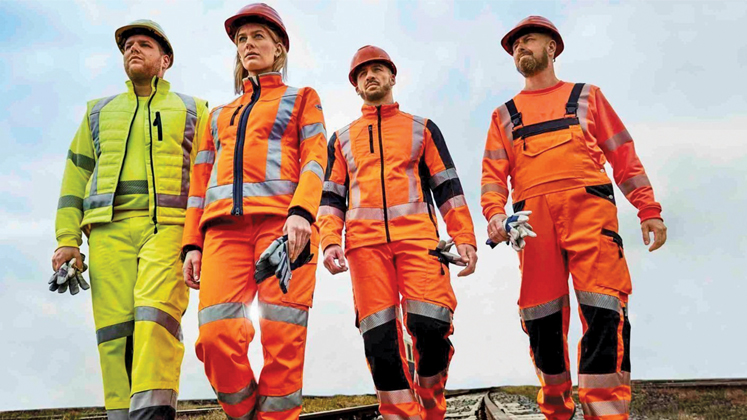
Uniforms
and Workwear on roll!
The global workwear and uniform
market was valued at US $ 75.63 billion in 2020 and is expected to reach US $
109.47 billion by the end of 2027, growing at a CAGR of 4.3 per cent (during
2021-2027) even if as per another report, the global uniform manufacturing
industry for the military, navy, fire brigade and police is worth around US $
370 billion.
Bangladesh’s export though
negligible, yet compared to the overall size of the market —defence dresses
fetch between US $ 400 million and US $ 500 million annually, according to
industry people —is set to rise as more and more take to uniform and workwear
manufacturing to increase market share and garner better price points.
“Currently, I am making uniforms for
the Belgian Army and the police of Kosovo,” claims Managing Director of Team
Group, Abdullah Hil Rakib.
Uniforms accounted for nearly 2 per
cent of Team Group’s total apparel export last year.
The volumes are low yet, felt the MD
of the group, who said Team Group can entertain more orders as it has the
capacity to do so.
Then there is Satexco, an early bird
in uniform making in Bangladesh, which is said to be serving the British Army
for long.
Speaking to Apparel Resources
(AR) earlier, Managing Director of the company Iqbal Hossain claimed
Satexco has been regularly supplying army jackets, rucksack, webbing,
ammunition pouch, water containers, bayonet holders, pistol holsters and heavy
tents.
“We also supply uniforms and other
defence-related products to some European countries including France, The
Netherlands, Belgium and Denmark. Sometimes we supply uniforms to UK’s Royal
Air Force as well,” claimed Iqbal, adding, “We make the uniform as per the
design and style supplied by the authorities concerned. The higher-ups of the
armies of the concerned countries regularly visit the manufacturing unit and
inspect production processes to ensure quality conformation. The uniforms and
other products are exported after being tested by a third country.”
Mirage Textiles is another name in
this direction, which even though not into making uniforms for the defence
forces except for the police, has been catering to the uniform/workwear
requirements of its clients from across the globe for quite some time now.
“Unlike fashion, the uniform business
is very stable. Our clients are mostly the airlines, restaurants, police and
electronics companies,” shares the Chairman of Mirage Textiles Pvt.
Ltd., Lalindra Yahatugoda, in an interview with AR.
Snowtex Group (an outerwear
exporter), which although does not produce uniforms for defence forces,
manufactures workwear and outerwear for fire-fighters, farmers, engineers and
other professionals and boasts of four manufacturing units namely Snowtex
Outerwear Limited, Snowtex Sportswear Limited, Snowtex Apparels
Limited and Cut and Sew Limited.
MPPE:
The growth driver
The COVID-19 pandemic, an unmatched
health disaster in recent human history, also offered an opportunity for
Bangladesh to exploit. As the world continued to grapple with the ramifications
of the pandemic, the demand for MPPE rose to an all-time high.
The second biggest apparel exporter
globally, Bangladesh did not miss this opportunity.
Since the early days of the
pandemic, when production of regular items took a backseat, garment makers took
to PPE making, claims Monirul Alam Shuvo from BGMEA, according to whom
at least 30 factories took PPE manufacturing initially only to witness the
numbers increase by the day.
“Just few days ago, we got an export
order to make 20 million surgical gowns. All our factories are now booked for
the entire year,” claims Fakir Apparels’ Director Mashiur Rahman Shommo,
who turned five of his factories into PPE plants as the Western clients came
calling in face of the initial onslaught of the pandemic.

One of the biggest names to take on
PPE-making actively was also the renowned Bangladesh business conglomerate
Beximco.
“It’s remarkable to see that within
this short span of two months, Bangladesh was able to foray into this very
regulated market with such a sensitive healthcare product,” felt Commerce
Minister Tipu Munshi, who has subsequently assured all possible assistance
from the Government by way of enabling policies and regulations to support
healthy growth of MPPE sub-sector while also offering duty exemption on taxes
for raw material imports.
Meanwhile, Deloitte has identified
12 MPPE products that bear high potential for development, which are namely
isolation gowns, coverall suits, masks (including surgical kn95 and n95), shoe
cover and head cover, gloves, protective spectacle, face shields, hand
sanitisers, bed linen, towel, melt-blown fabric and nursing pad even as CEO
of BUILD — Business Initiate Leading Development or BUILD is the
first-ever national public-private dialogue platform to promote private-sector
development through policy reforms —Ferdaus Ara Begum noted
Bangladesh is already making progress in the MPPE sector, especially in 12
products, including eight WHO-listed ones while adding the country’s garment
sector was the first to focus on the MPPE segment.
As per a recent study, Bangladesh
not only holds the capacity of producing 12 MPP products (as mentioned by
Deloitte) for domestic and global markets, but more than 50 firms in the
country have already obtained clearance from the Directorate General of Drug
Administration (DGDA), for making surgical masks, sanitisers and coveralls/PPE
gowns as well.
This only goes to show Bangladesh’s
competence is not only restricted to basic items but critical products as well,
including lingerie and intimate apparels.
Lingerie
in mix of things
A promising product category as it
is, manufacturing destinations are vying to make the most of the opportunities
that are on offer in lingerie — in 2019, Statista valued the global
lingerie retail market at US $ 32.07 billion, while Kenneth Research
expects the global lingerie market to reach an astounding US $ 62 billion by
2024 — and Bangladesh is, slowly but surely, lapping up the opportunities on
offer, as it moves up the ladder rather strongly, so it seems.

According to industry insiders,
Bangladesh’s annual lingerie export stands somewhere around US $ 700 million,
which not so long ago was merely half of it.
“If we can get hold of a portion of
the global lingerie market, our exports will go up significantly,” feels BGMEA
Vice-President Shahidullah Azim even as industry people underline
lingerie fetching better bargains vis-a-vis run of the mill products, was
proving to be a better bet for those who want to move beyond shirts, T-shirts
and denims to something more exciting in terms of profitability quotient.
Amongst the established names in
lingerie manufacturing are Apex Group, SQ Group, Hop Lun
BD, Blue Planet Knitwears, Chorka Textiles, KDS Group,
Zaber & Zubair, Mondol Group, Four H Group, Mahdeen
Group, etc., even if many new and overseas players are also getting into
the lingerie space lately.
Take, for example, Kaixi Fashion
Bangladesh Co. Ltd., the Chinese textile company which has recently announced
an investment of US $ 6 million for a new unit at Dhaka Export Processing Zone
to produce around 24 million pieces of ladies’ intimatewear annually.
Established in 1995, Kaixi
Fashion owns three subsidiaries (Shenzhen Kaixi Fashion Co., Ltd.,
Shantou Kaixi Lingerie Industrial Co. Ltd. and Myanmar Kaixi Lingerie
Industrial Co., Ltd.) and produces, distributes and sells products
ranging from traditional knitting lingerie bra, panties, to ‘invisible’ bra
pads and straps majorly to UK, France, Spain, Germany, Australia and Chile.
Meanwhile, home-grown player CTL or
Chorkha Textile Limited has invested around US $ 70 million to enhance
capacities since its inception in 2013 even if in fiscal 2020-21, CTL exported
lingerie worth US $ 90 million while Ananta Apparels, another big name in
lingerie in Bangladesh, has pumped in a massive Taka 250 crore to come up with
a sophisticated lingerie unit in the port city of Chittagong last year.
Given the eagerness amongst the
apparel makers to diversify their product basket by taking up new and exciting
items, industry insiders feel Bangladesh is now all set for the next step
towards attaining the much-needed manufacturing maturity.

The property, complete with 30-seat screening from room, a 100-seat amphitheater and a swimming pond with sandy shower…
The property, complete with 30-seat screening from room, a 100-seat amphitheater and a swimming pond with sandy shower…

The property, complete with 30-seat screening from room, a 100-seat amphitheater and a swimming pond with sandy shower…
The property, complete with 30-seat screening from room, a 100-seat amphitheater and a swimming pond with sandy shower…
The property, complete with 30-seat screening from room, a 100-seat amphitheater and a swimming pond with sandy shower…

We’ve invested every aspect of how we serve our users over the past Pellentesque rutrum ante in nulla suscipit, vel posuere leo tristique.
We’ve invested every aspect of how we serve our users over the past Pellentesque rutrum ante in nulla suscipit, vel posuere leo tristique.
We’ve invested every aspect of how we serve our users over the past Pellentesque rutrum ante in nulla suscipit, vel posuere leo tristique.
We’ve invested every aspect of how we serve our users over the past Pellentesque rutrum ante in nulla suscipit, vel posuere leo tristique.


We hate spam as much as you do
March 26, 2020
March 26, 2020
March 26, 2020
© Copyright 2020, All Rights Reserved


