


13
Islamabad
Severity: Warning
Message: Invalid argument supplied for foreach()
Filename: controllers/Main.php
Line Number: 51
Backtrace:
File: /home/textilet/public_html/application/controllers/Main.php
Line: 51
Function: _error_handler
File: /home/textilet/public_html/index.php
Line: 315
Function: require_once
Severity: Notice
Message: Trying to access array offset on value of type bool
Filename: controllers/Main.php
Line Number: 52
Backtrace:
File: /home/textilet/public_html/application/controllers/Main.php
Line: 52
Function: _error_handler
File: /home/textilet/public_html/index.php
Line: 315
Function: require_once


Archroma, a global leader in specialty chemicals towards sustainable solutions, today announced a strategic partnership with technology innovator CleanKore, aiming to advance sustainable dyeing processes throughout the denim supply chain.
Archroma, a global
leader in specialty chemicals towards sustainable solutions, today announced a
strategic partnership with technology innovator CleanKore, aiming to
advance sustainable dyeing processes throughout the denim supply chain.
The agreement will allow Archroma and CleanKore to promote the
benefits of each other’s technologies.
This includes Archroma’s robust catalog of dyes and specialty chemicals
along with CleanKore’s patented process of dyeing yarns at the denim mill that
completely eliminates the need for potassium permanganate (PP) spray and laser
booster to achieve the bright white abrasion effect in the garment finishing
process.
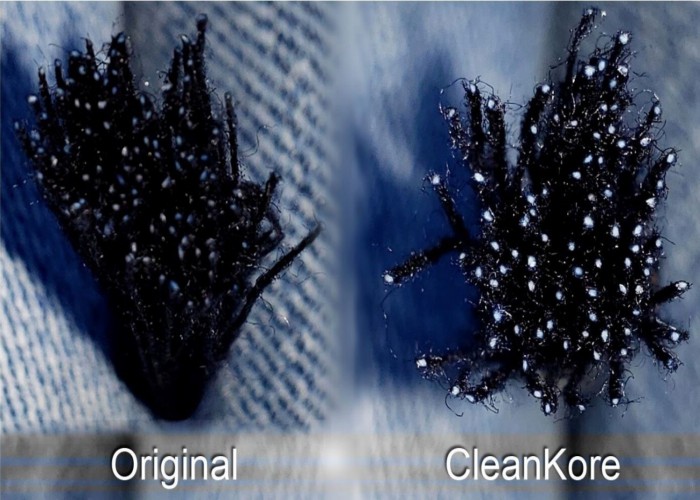
The result is a large and circular bright white core with a
small ring of indigo dye. The technology does not just eliminate the chemicals
associated in the PP spray and laser process, which is much safer for denim
workers, it also allows to save significant amounts of water and energy
throughout the manufacturing process from fabric to garmenting.

CleanKore initially looked at eliminating potassium permanganate
due to its being classified as hazardous if inhaled or ingested, or in case of
contact with the skin or the eye. It is also considered very toxic to aquatic
life.
No new equipment or capital expenses are needed to implement the
CleanKore technology, which works on all denim fabric, including dark indigo,
sulfur top/bottom and sulfur black.
This is where Archroma comes into the picture. Its global
technical team of denim coloration specialists will provide support to denim
mills seeking to implement the CleanKore technology and develop the desired
looks and effects - with the right colors and chemical systems for their
production set-up.
CleanKore estimates that the technology allows to save up to 15
liters of water per garment, or the equivalent to the drinking needs of 5
people per day, and up to 0.51 kWh of energy per garment, or the equivalent of
five 100-watt light bulbs on for 1 hour. The CleanKore technology also leads to
a 10% to 20% increase in production throughput, as a result of a faster garment
wash-down and the elimination of PP spray.
For CleanKore CEO Darryl Costin Jr., the announcement comes at
an ideal time for CleanKore: "We have successfully proven the technology
with mill partners such as Arvind and other denim mills in Pakistan,
Bangladesh, China, Vietnam, Thailand and the United States. The response from
the industry has been overwhelmingly positive. Having a partner in Archroma,
one that is highly respected for their innovation and emphasis on
sustainability throughout the industry, will allow us to take CleanKore to the
next level.”
Umberto Devita, Global Indigo Manager at the Archroma Global
Competence Center for Denim & Casualwear, adds: "CleanKore is
perfectly aligned with the 3 pillars of 'The Archroma Way to a Sustainable
World: Safe, efficient, enhanced'. 'Safe' through the elimination of a
potentially harmful substance and the protection of the denim workers,
'Efficient' through the reduction of resource consumption, improved
productivity and cost-effective profile. And 'Enhanced' through the gorgeous
colors and effects allowed with Archroma's innovations and systems, in
particular our aniline-free* Denisol® Pure Indigo and Diresul® sulfur dyes. We
look forward to help promoting an innovation that will help with many of the
challenges facing our denim customers throughout the world. Because it’s our
nature."

BÖNNIGHEIM (ivs) Textiles without
genetic engineering - when it comes to this concern, more and more consumers
are turning to organic cotton and are happy to accept higher prices for it.
This is because the cultivation of organic cotton requires the renunciation of
genetically modified seeds as well as chemical pesticides and fertilisers.
Nevertheless, genetic modifications are found time and again in textiles that are
actually labelled with the relevant organic labels. The conceivable causes of
contamination of organic cotton by genetic modifications are complex and extend
along the entire value chain. The textile testing service provider Hohenstein
is currently one of five laboratories in Europe that carries out accredited
testing of textiles for genetically modified organisms (GMO) in accordance with
the ISO/IWA 32:2019 protocol.
The protocol was developed by the
International Organisation for Standardisation (ISO) as an International
Workshop Agreement (IWA) on the initiative of Global Organic Textile Standard
(GOTS), Organic Cotton Accelerator (OCA) and Textile Exchange. The aim is to be
able to apply an official, standardised GMO testing protocol for textiles from
organic cultivation. According to this, all organic cotton must be free of
genetic engineering, whereas conventional cotton permits the use of genetic
engineering. In mid-February 2021, the initiators of the ISO/IWA 32:2019
protocol published an overview of the 14 testing laboratories worldwide that
are permitted to carry out tests in accordance with the protocol's
requirements, including the German testing service provider Hohenstein.
However, the Hohenstein experts
have also developed their own molecular biological detection systems in order
to be able to test genetically modified cotton at all critical points along the
entire value chain - from raw cotton to yarns and fabrics to finished end
products. Once we have been able to extract DNA, the screening allows full
traceability throughout the textile chain with clear yes/no statements about
GMO-free cotton or textiles. As a member institute of the OEKO-TEX®
Association, Hohenstein also screens textiles for genetically modified
organisms as part of the STANDARD 100 by OEKO-TEX® certification. If the
requirements are met, the articles can be advertised here with the claims
"organic cotton", "biological cotton" or "GMO not
detectable".
Manufacturers, brands and
retailers, but also certification organisations, benefit from complete
analytical evidence all the way to the end product: consumers can be confident
that no genetically modified cotton could be detected in the articles they buy.
This is because up to now most organic certifications either do not include any
obligatory laboratory tests at all or only random sample tests on cotton seeds.
More information:
www.hohenstein.com/gmo-testing
www.hohenstein.com
Two steps to 100 percent certainty
- Hohenstein GMO tests are carried out as follows:
1.
The sample is shredded and the cotton fibres are broken down
mechanically and enzymatically. The genetic material (DNA) is isolated from the
fibre and purified in a multi-stage process.
2.
A genetic modification exists if specific target sequences
(marker genes) are present in the DNA. These can be detected by molecular
biology. Control reactions are used to detect unmodified cotton DNA and to
exclude false-negative results.
About Hohenstein
Headquartered in Bönnigheim,
Germany, with 1,000 employees in its branches and laboratories around the
world, Hohenstein has been providing accredited and independent services such
as testing, certification, research and development of textile products and
training for more than 70 years. Product labels such as the Hohenstein Quality
Label or the UV STANDARD 801 support manufacturers and retailers in their marketing
activities. As a founding member, Hohenstein is also one of the most important
laboratories for testing within the framework of the OEKO-TEX® labels.
In
2019, Global Organic Textile
Standard (GOTS), the Organic Cotton Accelerator (OCA) and Textile Exchange partnered to develop the ISO IWA 32:2019 protocol1 to create a common
language among laboratories worldwide to screen for the potential presence of
genetically modified (GM) cotton along the organic cotton value chain.
Following
that project, the partners set out on a new initiative to bring much-needed
clarity regarding the laboratories that perform testing against the
international ISO reference protocol and carry out qualitative GMO testing in
cottonseed, leaf, fiber, and chemically unprocessed fiber-derived materials.
The
global ISO IWA 32:2019 proficiency test initiative is a collaboration
between GOTS, OCA and Textile Exchange with technical support from Wageningen Food Safety Research. The joint
project has reached a significant milestone: fourteen laboratories from China,
Germany, India, the Netherlands, and Portugal have successfully passed the
proficiency test. An overview of the
laboratories that
can currently conduct GMO testing as per the ISO IWA 32:2019 method has now
been jointly published by GOTS, OCA and Textile Exchange, which constitutes an
important milestone on the journey towards the widespread use of this
standardized protocol.
Bringing clarity on GMO testing methods for the organic cotton
sector, from seed to shirt
While
GMOs are excluded from organic systems, organic isn’t a claim of absolute
freedom from contamination or GMOs’ presence in organic products2.
It is a claim that GMOs are not deliberately or knowingly used and that organic
producers take far-reaching steps to avoid GMO contamination along the organic
cotton value chain, from farmers to spinners, to brands. To manage this, it is
essential that organic cotton stakeholders can reliably test their products for
the potential presence of GM cotton.
The
ISO IWA 32:2019 is a globally accepted reference protocol that was developed to
screen for the potential presence of genetically modified (GM) cotton. The
protocol provided the organic cotton sector with an essential tool for taking
all reasonable precautions to prevent GM cotton in their organic cotton produce
Since the publication of this globally accepted reference protocol, qualitative
GM cotton screening as per the ISO IWA 32:2019 is mandatory within the GOTS and
OCS (Organic Content Standard) supply chain and OCA’s Farmer Engagement and
Development program.
The
sector now recommends using the ISO IWA 32 protocol throughout
the organic cotton value chain as the only recognized method for GMO testing.
Therefore, the global ISO IWA 32:2019 proficiency test initiative’s success is
vital in building confidence among the industry.
Commenting
on the global ISO IWA 32:2019 proficiency test initiative, OCA’s Programme
Officer, Mathilde Tournebize, said: “As
a global platform, we are committed to increasing the clarity and reliability
of GMO screening for the organic cotton sector. The first results of the global
proficiency test initiative have given us an overview of the laboratories that
can be contacted to conduct such tests. We’re hopeful that as we see more
laboratories implementing the ISO IWA 32:2019 worldwide, several rounds of
proficiency tests will help us all chart the labs that can be contacted to
reliably conduct GMO tests. We are proud to be working in partnership with both
GOTS and Textile Exchange as we are united in our belief that this proficiency
test will contribute to standardising GMO testing along the organic cotton value
chain. Our ambition is to reach out to more laboratories and geographies to
increase the widespread use of the ISO IWA 32:2019 protocol.”
Rahul
Bhajekar, Managing Director at GOTS, added: “I
am glad to see a high level of interest from laboratories across the world and
results showing competence from producing and buying countries. We shall
continue to further advance this collaboration with like-minded organisations
to further develop the standardisation of GMO testing in cotton fibre products.
We remain committed to ensuring that GOTS goods are free from GMOs.”
Amish
Gosai, South Asia Manager at Textile Exchange, said: “The success of standardized
testing methods depends on adaptability and uniformed results. Labs achieving a
successful outcome in the proficiency test indicates both lab performance and
the effectiveness of this method. We are glad to see that this initiative shows
that the global ISO IWA 32 testing method gives consistent outcomes, and we
look forward to more labs joining the next round of the proficiency test.”
A first step into unifying the sector on GMO screening
The
ISO IWA 32:2019 proficiency test initiative will not cease with the current
laboratories; the joint initiative will be repeated regularly. More
laboratories are welcome to apply for the next round of proficiency test, which
will be organized, once sufficient demand has been reached.

The property, complete with 30-seat screening from room, a 100-seat amphitheater and a swimming pond with sandy shower…
The property, complete with 30-seat screening from room, a 100-seat amphitheater and a swimming pond with sandy shower…

The property, complete with 30-seat screening from room, a 100-seat amphitheater and a swimming pond with sandy shower…
The property, complete with 30-seat screening from room, a 100-seat amphitheater and a swimming pond with sandy shower…
The property, complete with 30-seat screening from room, a 100-seat amphitheater and a swimming pond with sandy shower…

We’ve invested every aspect of how we serve our users over the past Pellentesque rutrum ante in nulla suscipit, vel posuere leo tristique.
We’ve invested every aspect of how we serve our users over the past Pellentesque rutrum ante in nulla suscipit, vel posuere leo tristique.
We’ve invested every aspect of how we serve our users over the past Pellentesque rutrum ante in nulla suscipit, vel posuere leo tristique.
We’ve invested every aspect of how we serve our users over the past Pellentesque rutrum ante in nulla suscipit, vel posuere leo tristique.


We hate spam as much as you do
March 26, 2020
March 26, 2020
March 26, 2020
© Copyright 2020, All Rights Reserved


